Who Owns What in Music in 2026? Majors, Investment Funds, and Acquisitions

The music industry has never seen as many acquisitions, mergers, and investments as between 2023 and 2026. Universal acquires CD Baby for $775 million. Blackstone swallows Hipgnosis for $1.6 billion. Sony buys the Queen catalog for $1.27 billion. BMG negotiates Concord for potentially $7 billion.
Behind these staggering numbers lies a reality that directly affects independent artists: the tools they used to stay outside the major label system are, one by one, being bought by those very majors. CD Baby, AWAL, The Orchard, [PIAS], FUGA, all now belong to UMG or Sony.
This article takes stock of who owns what in music in 2026, and what it concretely changes for you.
The Big 3, Bigger than ever
In 2026, three groups control approximately 65-70% of the global market for recorded music. And their grip is only growing, no longer just over labels, but over the entire chain: distribution, publishing, technology, data.
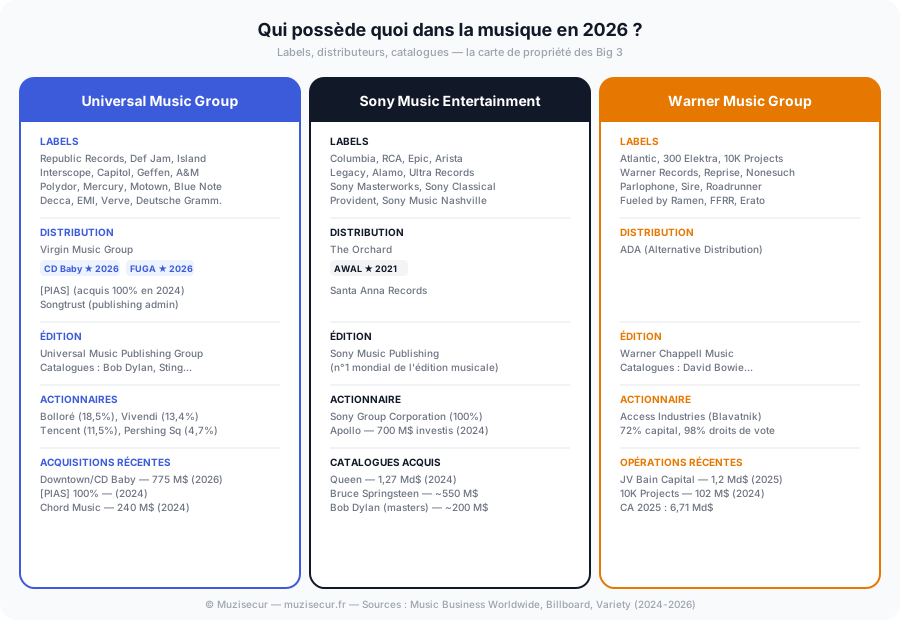
The Big 3 in 2026: labels, distribution, publishing, shareholders, and recent acquisitions.
Universal Music Group, The giant that swallows everything
UMG is the world’s largest music group, listed on the Amsterdam stock exchange. Its main shareholders:
- Bolloré (Vincent Bolloré): 18.5% of capital, 39.9% of voting rights
- Vivendi: 13.4% of capital
- Tencent (China): 11.5%
- Pershing Square (Bill Ackman): 4.7%
On the label side, UMG reorganized its operations in 2024:
- East Coast, Republic Corps: Republic Records, Def Jam, Island, Mercury
- West Coast, Interscope Capitol Labels Group: Interscope, Geffen, A&M, Capitol, Blue Note, Motown
- Plus: Polydor, Decca, EMI, Deutsche Grammophon, Verve
On the distribution side, this is where it gets staggering:
- Virgin Music Group, UMG’s indie distribution arm
- CD Baby + FUGA + Songtrust, acquired through Downtown for $775M (finalized February 2026)
- [PIAS], acquired 100% in October 2024
On the publishing side: Universal Music Publishing Group, with the catalogs of Bob Dylan (songwriting, $300-400M) and Sting ($300M).
Key takeaway: UMG is no longer content with signing artists. It now controls a large portion of independent distribution infrastructure. This is a paradigm shift.
Sony Music, The catalog king
Sony Music Entertainment is a subsidiary of Sony Group Corporation (Japan). It’s the second-largest group, but the world’s largest publisher through Sony Music Publishing (formerly Sony/ATV).
Labels: Columbia, RCA, Epic, Arista, Legacy, Alamo, Sony Masterworks, Sony Classical, Sony Music Nashville.
Distribution:
- The Orchard, the largest independent distributor attached to a major
- AWAL, acquired from Kobalt in 2021, approved by the CMA in 2022
Recent catalog acquisitions, Sony is the most aggressive on catalogs:
| Artist | Amount | Year |
|---|---|---|
| Queen (masters + publishing + image) | $1.27 billion | 2024 |
| Bruce Springsteen (masters + publishing) | ~$550M | 2021 |
| Bob Dylan (masters only) | ~$200M | 2021 |
| Michael Jackson (50% publishing/masters) | ~$600M | 2024 |
Key investor: Apollo injected $700 million into Sony Music Group in 2024 to fund catalog acquisitions.
Warner Music Group, Blavatnik’s war machine
Warner Music Group is controlled by Access Industries, Len Blavatnik’s conglomerate, which holds 72% of capital and 98% of voting rights. It’s the smallest of the Big 3, but the most agile.
2025 revenue: $6.71 billion.
Labels (reorganized in August 2024):
- Atlantic Music Group (Elliot Grainge): Atlantic, 300 Elektra, 10K Projects, Fueled by Ramen, Roadrunner
- Warner Records: Warner Records, Reprise, Nonesuch, Sire
- Plus: Parlophone, FFRR, Erato, Warner Classics
Distribution: ADA (Alternative Distribution Alliance).
Publishing: Warner Chappell Music, with David Bowie’s catalog (~$250M, 2022).
Major operation: in July 2025, Warner launched a $1.2 billion joint venture with Bain Capital to acquire “iconic” catalogs.
The CD Baby case, When independence joins the major
This is probably the acquisition that sparked the most debate in the independent artist community.
The facts:
- December 2024: UMG announces the acquisition of Downtown Music Holdings (owner of CD Baby, Songtrust, FUGA) through its subsidiary Virgin Music Group, for $775 million
- February 2026: the deal is finalized after EU approval (which required the divestiture of Curve Royalty Systems)
- Downtown founder Justin Kalifowitz departs the company
Why it’s seismic: CD Baby was the symbol of independent distribution. Hundreds of thousands of artists used it precisely to stay outside the major label system. They are now distributed by UMG.
Critics point to the risk that UMG gains excessive control over the technology, standards, and supply chain of the entire industry. Others put it in perspective: Virgin Music Group operates with a degree of autonomy, and CD Baby artists aren’t signing with a major, they’re using a distribution service.
Key takeaway: The CD Baby acquisition illustrates a major trend: majors are no longer just buying artists or catalogs, but the very infrastructure of independence.
Who owns your distributor?
This is the question every independent artist should be asking. Here’s the complete map in 2026:
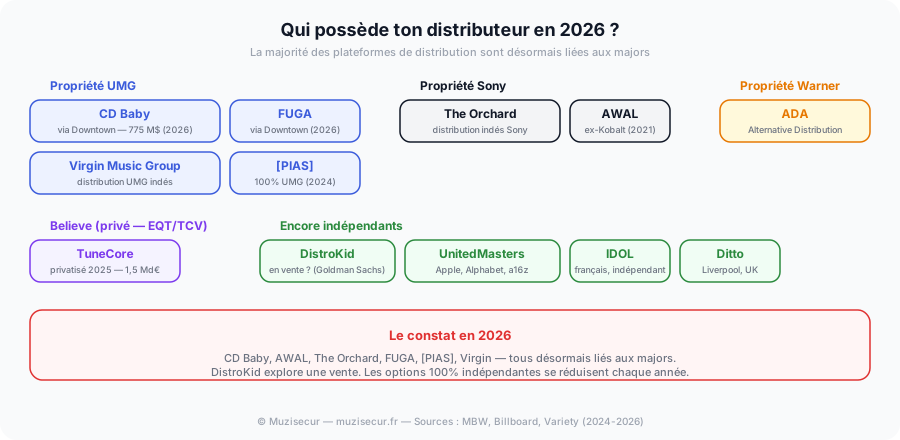
The majority of “independent” distributors now belong to a major or an investment fund.
| Distributor | Owner | Since |
|---|---|---|
| CD Baby | UMG (via Virgin/Downtown) | 2026 |
| FUGA | UMG (via Virgin/Downtown) | 2026 |
| Virgin Music Group | UMG | , |
| [PIAS] | UMG (100%) | 2024 |
| The Orchard | Sony Music | , |
| AWAL | Sony Music | 2021 |
| ADA | Warner Music | , |
| TuneCore | Believe (private, EQT/TCV) | , |
| DistroKid | Independent (for sale?) | , |
| UnitedMasters | Independent (Apple, Alphabet) | , |
| IDOL | Independent (French) | , |
| Ditto | Independent | , |
The reality: out of the 12 major distributors, 7 belong to the Big 3 or a privatized group (Believe). DistroKid is exploring a sale (Goldman Sachs and Raine were mandated in January 2026). If DistroKid falls into a major’s hands, the truly independent options will be reduced to UnitedMasters, IDOL, and Ditto.
To dive deeper into distribution, check our music distributor comparison.
Investment funds, The new bosses of music
The majors are no longer the only ones calling the shots. Private equity and investment funds have massively invested in music since 2020, attracted by streaming growth and the stability of catalog revenues.
Blackstone / Hipgnosis
In July 2024, Blackstone acquired Hipgnosis Songs Fund for $1.6 billion, beating the competing bid from Concord/Apollo. The catalog: over 45,000 titles, including Red Hot Chili Peppers, Neil Young, Shakira, Blondie.
Post-acquisition, the catalog was valued at $2.36 billion and Blackstone launched a $1.47 billion securitization (ABS) operation backed by royalties.
BMG, Soon the 4th major?
BMG (Bertelsmann subsidiary) is the most ambitious player in the market. In 2025, BMG broke all its records:
- 30 catalog acquisitions for $405 million
- Jason Aldean deal at $250 million (BMG’s largest single investment)
- Revenue: €900 million, record EBITDA margin at 32%
But the real game-changer is the negotiation with Concord, valued at approximately $7 billion. If the deal goes through, the combined BMG-Concord entity could become a serious competitor to the Big 3, with massive catalogs and distribution infrastructure.
Concord itself has accumulated acquisitions: Round Hill Music ($468.8M, 2023), Stem (2025), Ninja Tune (2026).
Apollo, Bain Capital, KKR
- Apollo: $700M injected into Sony Music (2024) to fund catalog acquisitions + facilitation of a $1.8 billion ABS deal for Concord
- Bain Capital: $1.2 billion joint venture with Warner Music (2025) to buy catalogs
- KKR: owned the Chord Music Partners catalog (65,000 titles including The Weeknd, John Legend, Lorde), partially sold to UMG for $240M (2024)
Goldman Sachs projection: global music revenues are expected to nearly double, from $104.9 billion (2024) to $196.8 billion by 2035. This projection is what attracts private equity.
Catalog acquisitions, The superstar jackpot
Catalog acquisitions have become the most spectacular segment of the industry. In 2021, it’s estimated that over $12 billion was spent solely on music rights acquisitions.
| Artist | Buyer | Estimated amount | Year |
|---|---|---|---|
| Queen (all-inclusive) | Sony Music | $1.27B | 2024 |
| Michael Jackson (50%) | Sony Music | ~$600M | 2024 |
| Bruce Springsteen | Sony Music | ~$550M | 2021 |
| Bob Dylan (songwriting) | UMPG | ~$300-400M | 2020 |
| Bob Dylan (masters) | Sony Music | ~$200M | 2021 |
| Sting (600+ titles) | UMPG | ~$300M | 2022 |
| David Bowie (publishing) | Warner Chappell | ~$250M | 2022 |
| Jason Aldean | BMG | $250M | 2025 |
Why these amounts? Superstar catalogs are treated as financial assets comparable to real estate. Streaming revenues are predictable, recurring, and growing. A well-exploited catalog can generate a yield of 8-12% per year, better than many traditional investments.
Believe and France, A special case
Believe is the largest French player in music distribution, and owner of TuneCore (global DIY distribution).
Timeline:
- February 2024: a consortium led by founder Denis Ladegaillerie + EQT + TCV launches a tender offer at €15/share (~€1.5 billion)
- March 2024: Warner Music expresses interest at €17+/share, then withdraws
- July 2025: Believe is definitively delisted from the Paris Stock Exchange (Euronext) at €17.20/share
Believe is now 100% private, with the stated ambition of becoming the “first global independent major.” The company also owns Nuclear Blast (metal), Naïve (classical/jazz), and operates in over 50 countries.
On the French indie side, the ecosystem holds:
- IDOL remains independent (founded by Pascal Bittard)
- Because Music (Emmanuel de Buretel) is independent
- Wagram Music remains independent
- The CNM (Centre National de la Musique) has warned about concentration risks and advocates for distribution channel diversity
What this changes for independent artists
The positive signals:
- Independent artists and labels represent 50% of all Spotify royalties in 2025
- Spotify paid out $11 billion to rights holders in 2025
- New models are emerging: fan communities, real-time royalties, AI-assisted production
The concerning signals:
- Truly independent distribution options shrink every year
- Consolidation gives majors increasing leverage in negotiations with platforms (rates, algorithms, visibility)
- Artists who used CD Baby to stay outside the majors are, de facto, distributed by UMG
What you can do:
- Be aware of who owns your tools, Knowing who controls your distributor means knowing who has a stake in your data and revenue
- Diversify your revenue streams, Don’t rely solely on streaming. Neighboring rights, sync, live, merch
- Keep control of your masters, This is your most valuable asset. Prefer license deals over artist contracts
- Get structured, A structured artist (label, company, SCPP/SPPF) carries more weight than an isolated artist on a DIY platform
Key takeaway: Consolidation is not inevitable. Independents account for 50% of the market. But to stay independent in a market that’s consolidating, you need to be structured, informed, and proactive.
FAQ, Music industry and acquisitions
Who acquired CD Baby in 2026?
Universal Music Group acquired CD Baby through its subsidiary Virgin Music Group, as part of the acquisition of Downtown Music Holdings for $775 million, finalized in February 2026.
What are the 3 major music labels in 2026?
The three majors are Universal Music Group (Bolloré/Vivendi/Tencent), Sony Music Entertainment (Sony Group Corporation), and Warner Music Group (Access Industries/Len Blavatnik). They control approximately 65-70% of the global recorded music market.
Who bought Hipgnosis Songs Fund?
Blackstone acquired Hipgnosis Songs Fund in July 2024 for $1.6 billion, beating the competing bid from Apollo/Concord. The catalog includes over 45,000 titles including those of the Red Hot Chili Peppers, Neil Young, and Shakira.
Which music distributors are still independent in 2026?
The main distributors still independent are DistroKid (exploring a sale), UnitedMasters (Apple/Alphabet), IDOL (French), and Ditto. The majority of others (CD Baby, AWAL, The Orchard, FUGA, [PIAS]) belong to the majors.
Will BMG become the 4th major?
BMG (Bertelsmann) is in negotiations to acquire Concord for approximately $7 billion. If the deal goes through, the combined entity could become a serious competitor to the Big 3. Nothing is confirmed as of early 2026.
Conclusion
In 2026, the music industry is more concentrated than ever. UMG, Sony, and Warner are no longer content with signing artists, they control distribution, publishing, technology, and increasingly, data. Investment funds (Blackstone, Apollo, Bain Capital, KKR) are injecting billions, treating catalogs as financial assets.
For independent artists and labels, the lesson is clear: independence is actively built. It doesn’t come from simply using a DIY distributor, since most now belong to the majors. It comes from a solid structure (label, company, organizations), mastery of your rights (masters, publishing), and revenue diversification.
If you want to structure your music business to keep control, Muzisecur helps you manage your rights, contracts, and royalties, so you remain truly independent.
Related articles

How to Create a Music Label in France: The Complete Guide (2026)
Legal structure, SCPP/SPPF, distribution, contracts, budget: every step to launch your independent label in France.

How to Add a Contact on Muzisecur: Complete Tutorial
Learn how to add a contact on Muzisecur in 3 steps using the creation link. The recommended method for labels and independent artists.

How to Manage Your Muzisecur Account: Profile, Mandates, and Subscription
Learn how to edit your personal information, add an artist profile, sign your mandates, and manage your subscription on Muzisecur.