How to Create a Music Label in France: The Complete Guide (2026)

You want to create your own music label? You’re not alone. In France, more and more producers, beatmakers, and independent artists are taking the plunge — and it makes sense. With the democratization of streaming and lower production costs, starting a label has never been more accessible. But between the idea and reality, there’s a gap: legal structures, membership in professional organizations, contracts, distribution, budget… If you don’t lay the right foundations from the start, you’re heading for trouble.
This guide gives you the 7 concrete steps to create your label in France, from the legal structure to the first release. No vague theory — just practical, field-tested advice.
Why create a label in 2026?
The music landscape has radically changed. Today, an artist can record at home, distribute their music in a few clicks, and reach a global audience. So why create a label rather than staying in self-distribution?
- Structure a catalog — A label gives a coherent artistic identity to a set of releases
- Share costs — Promotion, mastering, music videos, PR: with a label, you spread the investment
- Access neighboring rights — As a phonographic producer (through SCPP or SPPF), you receive equitable remuneration and private copy levies — money you don’t collect in self-distribution
- Build credibility — With bookers, media outlets, and partners, a structured label inspires trust
- Build an asset — A catalog of masters is an asset that grows in value over time
Key takeaway: Creating a label isn’t just releasing music under a name. It means becoming a phonographic producer — with the rights, obligations, and revenue that come with it.
Step 1 — Choose the right legal structure
This is the first decision, and probably the most consequential. Your legal structure will determine your taxation, your ability to sign artists, and your credibility with professional organizations.
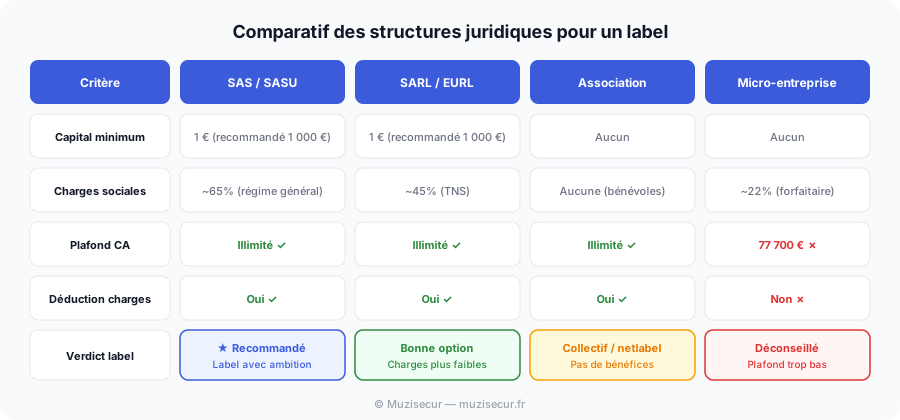
Comparison of the 4 possible legal structures for creating a label.
SAS / SASU — The choice of 90% of founders
The SAS (Société par Actions Simplifiée) — or SASU if you’re on your own — is the standard choice for a label with ambition. Why?
- Statutory freedom: you organize governance however you want
- General regime: the president is treated as an employee (better social protection)
- No revenue cap: you can grow without constraints
- Expense deduction: studio, promotion, mastering, travel — everything counts as business expenses
- Attracts investors: if you ever want to raise funds, this is the right structure
The minimum share capital is €1 (but €500 to €1,000 is recommended for banking credibility).
SARL / EURL — The budget-friendly alternative
The SARL offers a more rigid framework but lower social contributions (~45% vs ~65% for an SAS president). The manager operates under the TNS (self-employed) regime. It’s a good option if you want to minimize costs at launch, but governance is less flexible.
Non-profit association (loi 1901) — The collective format
The association works well for an artist collective or a netlabel without profit motive. You can join the SCPP or SPPF, distribute music, and collect rights. However, you cannot:
- Distribute profits to members
- Become a SACEM publisher
- Attract investors
Sole proprietorship (micro-entreprise) — Avoid it
The micro-entreprise is not recommended for a label:
- Revenue cap at €77,700 (services) — you’ll hit it quickly with a few releases
- No expense deduction: you can’t write off studio, promotion, or mastering costs
- Impossible to sign a proper artist contract with rights assignment
- Zero credibility with organizations and partners
Key takeaway: For a label with real ambitions, SAS/SASU is the default choice. SARL is a viable alternative. The association works for collectives. The micro-entreprise is a trap.
Step 2 — Register your company
Once you’ve chosen your structure, here are the steps:
- Draft the articles of association — You can use an online template or work with a professional (recommended for label-specific clauses). Cost if you do it yourself: €0. Through a lawyer or specialized service: €500 – €1,500
- Deposit the share capital — Into a dedicated professional bank account
- Publish a legal notice (JAL) — Mandatory, cost: €150 – €250 depending on your department’s rate schedule
- Register on the Guichet Unique — Since 2023, all formalities go through procedures.inpi.fr. Registry fees: €37 – €70. You’ll get your SIRET number and your NAF code (usually 5920Z — sound recording)
- Receive your Kbis extract — This is your company’s “ID card.” You’ll need it for everything: bank account, SCPP/SPPF, distributor
Timeline: expect 2 to 4 weeks between filing and receiving the Kbis.
Good to know: With the Muzisecur Label account, we handle the creation of your legal structure for you — drafting the articles of association, registration, obtaining the SIRET. You save on setup fees and gain time to focus on your catalog.
Step 3 — Trademark your name at INPI
This is a step many labels overlook — and later regret. Registering your label name at INPI legally protects you against any use by a third party.
- Cost: €190 for one class, +€40 per additional class
- Recommended classes: class 9 (sound recordings), class 41 (show production, training), class 35 (advertising, management)
- Duration of protection: 10 years, renewable indefinitely
- Prior check: search for existing trademarks on data.inpi.fr before filing
Key takeaway: A label without a trademark is a label that risks having to change its name overnight. €190 is the price of peace of mind.
Step 4 — Join SCPP or SPPF
As a phonographic producer, you’re entitled to revenue you will never receive if you don’t join one of these two organizations:
- Equitable remuneration — paid for every radio, TV, and public venue broadcast
- Private copy levy — collected on blank media (USB drives, hard drives, smartphones…)
These are passive revenues, proportional to the broadcast of your catalog. And many new labels miss out — simply because they don’t know it exists.
To learn more about neighboring rights, equitable remuneration, and the choice between SCPP and SPPF, check our article Neighboring Rights in Music: Phonographic Producer Royalties.
Step 5 — Set up your distribution
A label without distribution is an invisible catalog. You need to choose an aggregator-distributor that will place your releases on all streaming platforms.
| Distributor | Model | Commission | Strengths |
|---|---|---|---|
| Believe / TuneCore | Commission | Variable | International network, marketing services |
| IDOL | Commission | ~15-25% | Indie specialist, excellent support |
| iMusician | Commission or flat fee | 15% or flat/release | Flexible, suited for small labels |
| DistroKid | Subscription | ~€20/year unlimited | Cheap, but limited services |
| Ditto | Flat fee | 0% commission | Good value for money |
Selection criteria: look beyond the price. A good distributor offers playlist pitching, advanced analytics, responsive support, and strong international coverage.
For a detailed comparison, check our article Digital Music Distribution Comparison.
Step 6 — Prepare your contracts
No label without contracts. This is the legal foundation of your relationship with every artist, and it’s what protects both parties.
Artist contract vs license deal vs distribution deal
| Artist contract | License deal | Distribution deal | |
|---|---|---|---|
| Master ownership | Label | Artist | Artist |
| Artist royalties | ~8-12% | ~20-30% | ~60-80% |
| Label investment | High (studio, promo, videos) | Medium (promo, marketing) | Low (platform placement) |
| Typical profile | Emerging artist | Self-produced artist | Autonomous artist |
| Typical duration | 3-5 years or X albums | 2-3 years | Release by release |
Key negotiation points: duration, territory, exclusivity, advance (recoupable but non-refundable), and especially reversion clauses — when the artist gets their masters back.
To dive deeper into this topic, read our guide Artist Contract vs License Deal and Essential Contracts for Independent Artists.
Key takeaway: Never copy a contract found on the Internet. Have your contracts drafted or reviewed by a lawyer specialized in music law. It’s an investment, not an expense.
Step 7 — Release your first track
This is the moment of truth. Your first release will set the standards for your label. Here’s the checklist:
- Finalize the master — Professional mixing + mastering
- Obtain ISRC codes — Through your SCPP/SPPF or your distributor
- Prepare the artwork — Square visual 3000x3000px minimum, follow platform guidelines
- Write the metadata — Artist, title, songwriters, producer, release date
- Upload to your distributor — At least 4 weeks before the release date
- Pitch to playlists — Via Spotify for Artists and your distributor’s tools
- Launch promotion — Social media, press relations, mailing list
- Declare the release — To your SCPP or SPPF within 30 days
For a complete checklist, check Release a Single Independently: The Checklist.
Budget — How much does it cost to create a label?

Overview of the 7 steps and estimated budget for launching an independent label.
Here’s a realistic budget for a small independent label in 2026:
| Item | Range |
|---|---|
| Legal notice publication (JAL) | €150 – €250 (depending on department rate) |
| Registry fees (RCS registration) | €37 – €70 |
| Articles of association drafting + formalities (if not with Muzisecur) | €500 – €1,500 |
| INPI trademark registration | €190 – €270 |
| SCPP or SPPF share | €50 – €153 |
| First release (mastering, artwork, promo) | €500 – €2,000 |
| Contracts (lawyer drafting) | €500 – €1,500 |
| Total | €2,000 – €5,500 |
Pro tip: With the Muzisecur Label account, articles of association drafting and incorporation formalities are included — you only pay the mandatory fees (JAL + registry + INPI).
Advice: systematically set aside 30-40% of your revenue for social contributions and taxes. And keep a working capital reserve of at least 20% of your annual budget.
The 7 mistakes that kill an independent label
- Choosing micro-entreprise — Revenue cap too low, no expense deduction, zero credibility
- Not trademarking your name — Risk of forced rebranding and damages
- Copying contracts from the Internet — Vague clauses on reversion, royalties, duration → guaranteed litigation
- Forgetting SCPP/SPPF — It’s “free” money you’ll never collect without membership
- Neglecting accounting — 60% of label failures come from poor financial management
- Signing too many artists too fast — A label can only effectively promote 3-5 releases simultaneously
- Under-investing in promotion — If you spend less than 30% of your budget on promo, nobody will hear your releases
Key takeaway: Most labels don’t die from a lack of artistic talent, but from administrative failure. Structure your processes from day one.
To dive deeper into this topic, read our guide Independent Label: Structuring Your Artist Administration.
Going further — The book and the conference
If you want an even more detailed guide on creating a label, I wrote an entire book on the subject: “Créer son label de Musique” (Create Your Music Label), available on Amazon. It covers everything in this article and much more: contract templates, business plans, development strategy, roster management, real case studies.
And if you prefer video format, you can watch the replay of my conference “The 7 Steps to Create Your Label” at the top of this article — I break down each step with concrete examples from my experience as a producer and founder of Muzisecur.
FAQ — Creating your music label
What legal structure should you choose to create a music label?
SAS or SASU is recommended for a label with growth ambitions. It offers complete statutory freedom, a favorable social regime (general regime), and the ability to deduct all your professional expenses. Sole proprietorship (micro-entreprise) is not recommended due to the revenue cap at €77,700 and the inability to deduct expenses.
How much does it cost to create a music label in France?
The startup budget ranges from €2,000 to €5,500: legal notice publication (€150-250), registry fees (€37-70), articles of association drafting + formalities (€500-1,500, included with Muzisecur Label account), INPI trademark registration (€190-270), SCPP/SPPF share (€50-153), first release (€500-2,000), and lawyer-drafted contracts (€500-1,500).
Do you need a lawyer to create a music label?
It’s not mandatory for registration, but it’s strongly recommended for contracts. A poorly drafted artist contract can be very costly in litigation. Budget €500 to €1,500 to have your standard contracts drafted by a lawyer specialized in music law.
Do you need a distributor to release music with a label?
Yes. An aggregator-distributor (Believe, IDOL, iMusician, DistroKid…) places your releases on Spotify, Apple Music, Deezer, etc. The business model varies: annual subscription, revenue commission, or per-release fee.
What is the difference between an artist contract and a license deal?
With an artist contract, the label owns the masters and the artist receives ~8-12% in royalties. With a license deal, the artist keeps their masters and grants temporary exploitation to the label for 20-30% in royalties. The choice depends on who funds the production.
Can you create a label as a non-profit association (loi 1901)?
Yes, an association can operate as a label, join the SCPP/SPPF, and distribute music. But it cannot distribute profits to its members or become a SACEM publisher. It’s a good format for a non-profit collective.
Conclusion
Creating a music label in France in 2026 is more accessible than ever — but it remains a real entrepreneurial project. The 7 steps are clear: choose your structure, register, trademark your name, join SCPP/SPPF, sign with a distributor, prepare your contracts, and release your first track.
The key is to not skip steps. Lay the legal and administrative foundations before rushing into releases. A well-structured label from the start is a label that lasts.
And if you want to go further, my book “Créer son label de Musique” (Create Your Music Label) on Amazon is the logical next step after this article. You’ll find contract templates, business plans, and case studies to go from theory to action.
And if you want to get started without the paperwork headache, the Muzisecur Label account includes the creation of your legal structure (articles of association, registration, SIRET) and then centralizes all your artist management, contracts, rights, and royalties — so you can focus on the music.
Related articles

Who Owns What in Music in 2026? Majors, Investment Funds, and Acquisitions
UMG acquires CD Baby, Sony buys Queen, Blackstone swallows Hipgnosis: the complete map of who owns what in the music industry.

Cover Songs: What Rights, Permissions, and Royalties Apply?
Covering a song in France involves specific rights. This guide details the permissions, licenses, and royalties for every platform.

How to Add a Contact on Muzisecur: Complete Tutorial
Learn how to add a contact on Muzisecur in 3 steps using the creation link. The recommended method for labels and independent artists.