Neighboring Rights in Music: How to Collect All Your Royalties as a Producer

You produce music. You distribute your tracks on platforms. You collect your streams through your distributor. And you think that’s it, you’re receiving all your revenue.
Wrong. If you’re not registered with SCPP or SPPF (the two French collecting societies for phonogram producers), you’re literally leaving money on the table. Every radio play, every broadcast in a store, every smartphone sold in France generates neighboring rights that you’re entitled to as a phonogram producer — and that nobody will pay you if you don’t take the necessary steps.
In this article, we explain everything: what neighboring rights are, the 3 revenue streams you need to know about, the difference between SCPP and SPPF, how to register, and why the majority of independent producers miss out on hundreds (or even thousands) of euros every year.
What are neighboring rights exactly?
Neighboring rights (also called “rights neighboring on copyright”) have been recognized by French law since 1985 (the Lang Act) for three categories of people:
- Performing artists (singers, musicians) — managed by ADAMI and SPEDIDAM
- Phonogram producers (those who fund the recording)
- Audiovisual communication companies (radio, TV)
If you fund the production of a recording — even if it’s your own project, even if you did everything in your bedroom — you are a phonogram producer under the law. And as such, you are entitled to payment every time your recording is publicly broadcast or copied.
Key takeaway: Copyright protects the work (the composition, the lyrics). Neighboring rights protect the recording itself — the sound fixed on a medium. These are two distinct rights that generate two separate revenue streams.
The distinction is fundamental. You can be a songwriter-composer AND a producer. In that case, you’re entitled to both types of revenue. But if you don’t take the steps for each, you only receive half of what you’re owed.
The 3 revenue streams from neighboring rights
As a phonogram producer, you can earn revenue from three distinct sources. Each has its own collection and distribution mechanism.
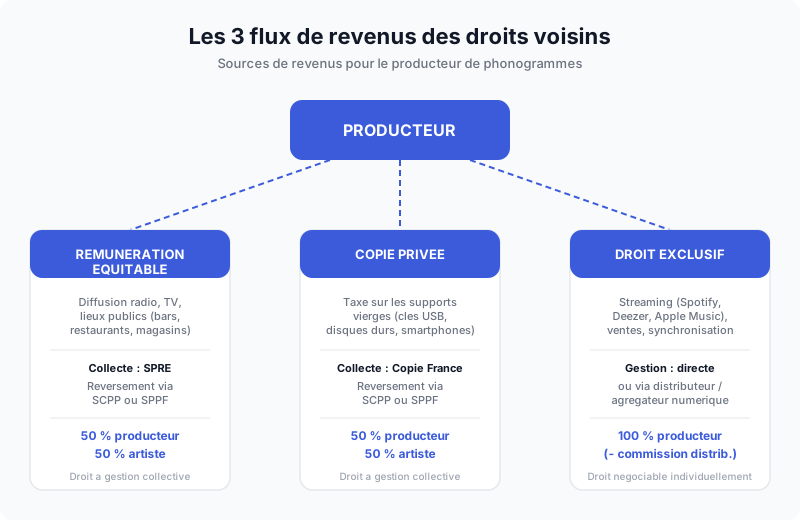
The 3 neighboring rights revenue streams for phonogram producers.
Let’s break down each stream.
Stream 1: equitable remuneration
Where does this money come from?
Equitable remuneration is compensation paid to performing artists and producers when their music is broadcast in public places. Specifically, every time your music is played:
- On radio (FM, DAB+, web radio)
- On television (jingles, soundtracks, reports)
- In public venues: bars, restaurants, hotels, waiting rooms, shopping centers, hair salons, etc.
…a fee is due. This fee is collected by SPRE (Societe pour la Perception de la Remuneration Equitable), a joint body.
How is it distributed?
The law mandates a strict split: 50% for performing artists and 50% for producers. The producer share is then paid out by your collecting society — either SCPP or SPPF.
The amount you receive depends directly on how often your tracks are broadcast. The more your music is played on radio or TV, the more you earn. That’s why declaring your catalog to your society is crucial: if your tracks aren’t in their database, they can’t distribute the corresponding sums to you.
How much does it represent?
To give you an order of magnitude: SPRE collects around 150 million euros per year in equitable remuneration. Half (75 million euros) goes to producers. It’s a substantial pot, and every registered producer receives a share proportional to their broadcasts.
An independent producer whose tracks regularly get regional radio play can earn between 500 and 5,000 euros per year from equitable remuneration alone. For a producer whose artist has a track in national rotation, it can climb to tens of thousands of euros.
Key takeaway: Equitable remuneration is an automatic right linked to public broadcast. But to collect it, you must be registered with SCPP or SPPF and have declared your catalog.
Stream 2: private copying
Where does this money come from?
Private copying is a typically French (and European) mechanism that compensates rights holders for copies made privately by consumers. When someone buys a smartphone, a USB stick, an external hard drive, a tablet, or even a connected TV, a levy is included in the sale price. This levy is collected by Copie France.
How is it distributed?
The collected money is then distributed among the various categories of rights holders: songwriters, performing artists, and producers. The producer share is paid through SCPP and SPPF, proportionally to each catalog’s sales and broadcasts.
In practice, distribution is based on your sales declarations (units sold, number of streams). The more your catalog generates in sales and listens, the larger your private copying share.
How much does it represent?
Copie France collects around 300 million euros per year (all categories combined). The phonogram producers’ share represents a significant portion of this sum.
For a small label with an active catalog, private copying can represent between 200 and 2,000 euros per year. It’s not a jackpot, but it’s money you’re owed and that you’ll never receive if you’re not registered.
Key takeaway: Private copying money is collected whether you’re registered or not. The difference is that if you’re not registered, your share stays in the common pot and benefits other producers.
Stream 3: exclusive rights
Where does this money come from?
Exclusive rights are fundamentally different from the first two streams. Here, it’s not about mandatory collective management but about your right to control the exploitation of your recordings. As a producer, you have the monopoly to authorize or prohibit:
- The reproduction of your phonograms (pressing, digital copying)
- Making available to the public (streaming, downloads)
- Synchronization (use in a film, an ad, a video game)
It’s your exclusive right that allows you to sign a contract with a digital distributor (DistroKid, TuneCore, iMusician, etc.) and earn royalties on Spotify, Apple Music, Deezer, and other platforms.
How is it distributed?
Unlike equitable remuneration and private copying, exclusive rights are not collectively managed. You negotiate the terms of exploitation with your partners (distributors, labels, sync agencies). The percentage you earn depends on your contracts.
With a standard aggregator, you keep between 80 and 100% of streaming and download revenue (minus the aggregator’s commission). With a label, the split varies depending on the type of contract (see our article on artist contract vs license deal).
Why is it important to distinguish all three?
Many producers think that streaming revenue covers everything. That’s wrong. Streaming royalties fall under exclusive rights — that’s one of the three streams. The other two (equitable remuneration and private copying) are additional revenue you miss if you don’t take the steps.
Key takeaway: Exclusive rights are what you already manage through your distributor. “Collective” neighboring rights (equitable remuneration + private copying) are a bonus you must activate separately by joining SCPP or SPPF.
SCPP or SPPF: how to choose?
In France, two collecting societies share the management of neighboring rights for phonogram producers: SCPP and SPPF. You can only join one — the choice is exclusive.
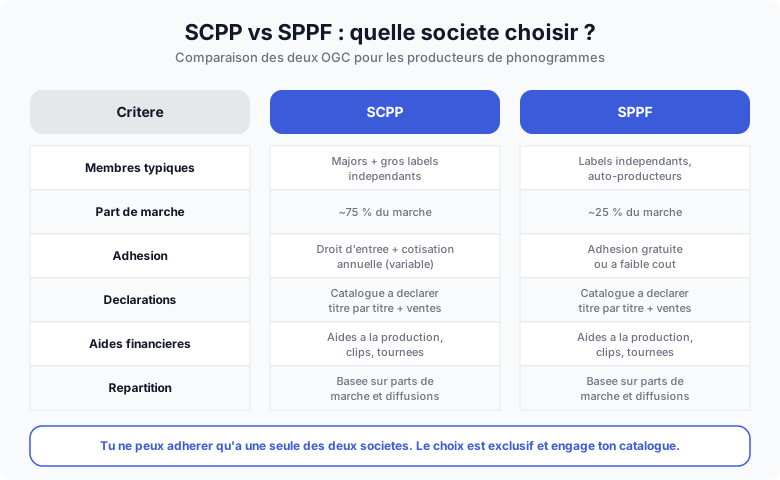
Comparison between SCPP and SPPF for phonogram producers.
SCPP (Societe Civile des Producteurs Phonographiques)
SCPP historically groups the majors (Universal, Sony, Warner) and large independent labels. It represents about 75% of the French phonographic market in terms of market share.
SCPP manages a massive catalog and has significant resources for distribution. It also offers financial grants to producers for production, promotion, music videos, and tours.
Joining SCPP involves an entry fee and an annual subscription. Amounts vary depending on the size of your catalog and your revenue.
SPPF (Societe civile des Producteurs de Phonogrammes en France)
SPPF is historically the society for independent labels. It represents about 25% of the market but has a much larger number of members, since most small labels and self-producers join here.
Membership is generally more accessible in terms of cost. SPPF also offers financial grants, with allocation committees that take the reality of independents into account.
What criteria to consider?
| Criterion | SCPP | SPPF |
|---|---|---|
| Typical profile | Majors, large indie labels | Small labels, self-producers |
| Market share | ~75% | ~25% |
| Membership cost | Entry fee + subscription | More accessible |
| Financial grants | Yes (large budget) | Yes (adapted to independents) |
| Support | Large structure | Closer to members |
| Declarations | Catalog + annual sales | Catalog + annual sales |
In practice, if you’re a self-producer or a small independent label, SPPF is often the most natural choice. If you’re a mid-sized label with a substantial catalog and want access to the highest grants, SCPP may be more relevant.
Key takeaway: The choice between SCPP and SPPF is not trivial. It commits your entire catalog. Take the time to compare membership conditions, grant schedules, and services offered before deciding.
Why most producers miss out
Here’s the paradox: music neighboring rights represent considerable sums, but a huge proportion of independent producers don’t collect them. Here are the main reasons.
1. Confusion between copyright and neighboring rights
Many producers are registered with SACEM (as songwriters-composers) and think that’s enough. SACEM manages copyright — the rights tied to the composition and lyrics. Neighboring rights are a different world, with different societies (SCPP/SPPF), different procedures, and different revenue.
2. Pure ignorance
Nobody tells you about it. Not your aggregator (DistroKid, TuneCore), not your bank, not your accountant. Neighboring rights are a blind spot in the industry for independents. The majors and big labels have had dedicated teams managing this for decades.
3. Administrative complexity
Let’s be honest: the procedures aren’t trivial. You need to put together a membership application, declare each track in your catalog (with ISRC codes, credits, release dates), then declare your sales every year before March 31. For a producer releasing 20 tracks a year, that’s a non-trivial administrative workload.
4. No unlimited retroactivity
If you register today, you can’t recover all the neighboring rights from the last 10 years. Retroactivity is limited (generally to 3 years for sums not yet distributed). Every year you spend without being registered is money permanently lost.
5. Forgotten annual declarations
Even those who are registered often forget to file their annual sales declaration. The result: their rights are poorly distributed, undervalued, or sometimes not paid at all. It’s a double penalty.
Key takeaway: Neighboring rights money is collected whether you’re registered or not. If you do nothing, your share goes into the common pot and benefits those who did take the steps. The longer you wait, the more you lose.
How to register and declare your recordings
Here is the concrete path to start collecting your neighboring rights.
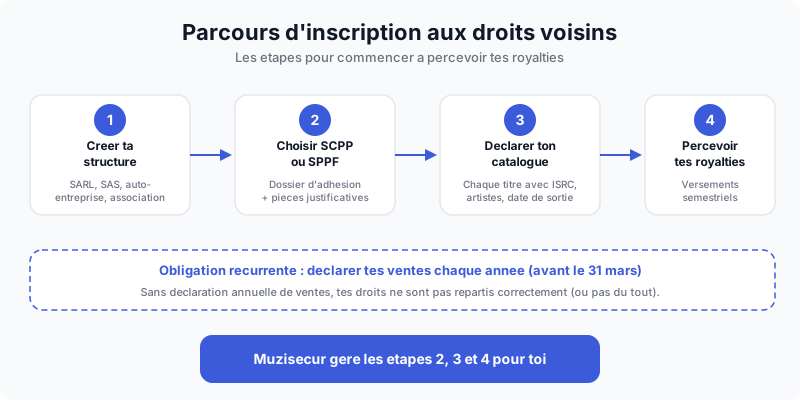
The neighboring rights registration path, step by step.
Step 1: verify that you are indeed a phonogram producer
To join SCPP or SPPF, you must be able to prove that you are the producer of the recordings you declare. This means you funded and initiated the fixation of these recordings.
If you’re an artist who funded your own recording sessions, you are the producer. If you have a label that paid for the studio, the label is the producer. The contract between you determines the split.
You must have a legal structure: a company (SARL, SAS in France), an association, or even a sole proprietorship. Collecting societies do not accept individual memberships without a structure.
Step 2: put together your membership application
For both SCPP and SPPF, you will need to provide:
- Company registration certificate (Kbis extract in France, or declaration receipt for associations)
- Company bylaws
- Professional bank details
- Catalog list with ISRC codes
- Production contracts (or proof of your producer status)
- ID of the legal representative
Processing the application generally takes between 2 and 6 weeks.
Step 3: declare your catalog
Once you’re a member, you must declare each phonogram in your catalog. For each track, you need to provide:
- The title of the recording
- The ISRC code (International Standard Recording Code)
- The performing artist(s)
- The date of first commercialization
- The musical genre
- The format of commercialization (digital, CD, vinyl)
This declaration can be done online through the dedicated platforms of SCPP or SPPF. It’s meticulous work but essential: an undeclared track is a track for which you’ll never be paid.
Step 4: don’t forget new releases
Every time you release a new single, EP, or album, remember to declare it to your society. It’s a habit to build, just like registering your works with SACEM.
The annual sales declaration: the step everyone forgets
Being registered and having declared your catalog is necessary but not sufficient. Every year, you must submit your annual sales declaration to your collecting society.
Why it’s crucial
The distribution of neighboring rights is not based solely on radio/TV broadcasts. It also accounts for your market share, meaning the volume of sales and streams in your catalog. If you don’t declare your sales, your society can’t correctly calculate your share.
What data to provide?
You must submit:
- The number of units sold per track (physical and digital)
- The number of streams per track
- The revenue generated by your catalog
- Territory-level data if possible
This data is available in the dashboards of your aggregator/distributor (TuneCore, DistroKid, iMusician, Believe, etc.). You need to extract it, format it according to the template required by your society, and submit it before March 31 each year.
What happens if you don’t do it
If you don’t submit your sales declaration:
- Your rights are calculated on incomplete or outdated data
- You receive less than you should
- In some cases, your rights are simply not distributed
This is the most common mistake among independent producers. They make the effort to register, declare their catalog once, then never send their sales figures again. The result: they receive a fraction of what they’re owed.
Key takeaway: The annual sales declaration is just as important as the registration itself. Without it, your neighboring rights are miscalculated and undervalued. It’s an annual appointment you must never miss.
How much can you earn from neighboring rights?
The question everyone asks. The answer obviously depends on the size of your catalog, your broadcasts, and your sales. Here are realistic orders of magnitude.
For a beginner self-producer
- Catalog: 5-15 tracks
- A few plays on local or web radio
- A few thousand streams per month
- Estimated neighboring rights: 100 to 500 euros / year
It’s modest, but it’s free money you weren’t collecting.
For a small active label
- Catalog: 30-100 tracks
- Regular radio play (regional + some national)
- Tens of thousands of streams per month
- Estimated neighboring rights: 1,000 to 8,000 euros / year
Now it starts to become significant. Over 5 years, that’s between 5,000 and 40,000 euros you would have left on the table without registration.
For a label with a track in national rotation
- One or more tracks on national radio playlists (NRJ, Skyrock, Fun Radio, France Inter…)
- Hundreds of thousands of streams per month
- Estimated neighboring rights: 10,000 to 50,000+ euros / year
At this level, not being registered with SCPP or SPPF is a major financial mistake.
The calculation nobody makes
Let’s take a concrete example. You’re an independent producer, you release 4-5 projects per year, your artists get some radio play and accumulate 100,000 streams per month. You neglect neighboring rights for 5 years.
Over that period, you could have collected between 5,000 and 15,000 euros cumulatively in equitable remuneration and private copying. That money was collected — but it was distributed among the producers who actually took the steps.
Muzisecur manages your neighboring rights from A to Z
At Muzisecur, we know that admin is the nightmare of independent producers. That’s why we’ve included neighboring rights management in our services.
What we do concretely
- SCPP/SPPF membership: we help you choose the society best suited to your profile and put together your membership application from A to Z
- Catalog declaration: we declare each track in your catalog to your society, with all the required metadata (ISRC, credits, dates)
- Annual sales declaration: every year before March 31, we compile your sales and streaming data and submit it in the required format
- Payment monitoring: we verify that your rights are properly distributed and paid
Why it’s important to delegate this
Managing neighboring rights requires rigor and consistency. An error in an ISRC code, a track missing from your declaration, a sales form submitted late — and you lose revenue. By entrusting this to Muzisecur, you make sure nothing slips through the cracks.
You focus on your music. We handle the rest.
FAQ
What is the difference between SCPP and SPPF?
SCPP represents the majors and large independent labels (about 75% of the market). SPPF is the society for independent labels and self-producers (about 25% of the market). Both fulfill the same mission — collecting and distributing equitable remuneration and private copying levies — but their membership conditions and grant programs differ. You can only join one of the two.
Are neighboring rights and copyright the same thing?
No. Copyright (managed by SACEM) protects the musical work (composition, lyrics). Neighboring rights (managed by SCPP or SPPF) protect the sound recording. A songwriter-composer who is also a producer must register with both to receive all their revenue.
Can I collect neighboring rights as a self-producer?
Yes, absolutely. As long as you funded the recording of your music, you are a phonogram producer under French law. Whether you are a solo artist or run a label, you are entitled to neighboring rights. You simply need a legal structure (sole proprietorship, association, or company) to join.
How long does it take to start receiving neighboring rights?
Allow about 2 to 6 weeks for your application to be processed. Once accepted and your catalog declared, the first payments arrive at the next distribution session of your society (usually twice a year). In practice, expect between 3 and 9 months before receiving your first payment.
Are neighboring rights retroactive?
Partially. When you register, you can benefit from retroactivity on sums not yet distributed, generally covering the last 3 years. But rights already distributed are lost. Hence the importance of not waiting.
Does my distributor (DistroKid, TuneCore) handle this?
No. Your distributor only handles the exclusive right — i.e., streaming and download revenue. Equitable remuneration and private copying are separate streams that require separate registration with SCPP or SPPF. No distributor does this for you.
What are the annual obligations once registered?
You must submit your annual sales declaration before March 31 each year. You must also declare each new release. And you must keep your information up to date (bank details, legal status, etc.).
Conclusion
Music neighboring rights are one of the best-kept secrets in the industry for independent producers. Three revenue streams — equitable remuneration, private copying, and exclusive rights — and most independents only collect one (streaming revenue through their distributor).
The good news is that the steps aren’t insurmountable. The bad news is that every month that passes without registration is a month of lost revenue.
If you want to maximize your income without drowning in admin, Muzisecur handles your registration, catalog declaration, and annual sales declarations with SCPP or SPPF for you.
Stop leaving money on the table. Your recordings generate neighboring rights — it’s time to collect them.
Related articles

ADAMI and SPEDIDAM: The Complete Guide for Performing Artists
ADAMI or SPEDIDAM? Understand the difference, register with the right organization, and finally collect your performer rights. Practical guide with steps, grants, and mistakes to avoid.

Music Copyright: How It Actually Works
Songwriter, composer, producer, performer: who gets paid what and why? Understand copyright, neighboring rights, and private copying in music.

Annual Sales Declaration SCPP SPPF: The Complete Guide to Collecting Your Neighboring Rights
How to declare your sales to SCPP or SPPF and collect your producer neighboring rights. The 5 steps, the pitfalls, and the essential codes.