Featuring Contract: What You Must Plan Before Recording

You’re preparing a featuring with another artist. The energy is right, the beat is locked in, you’re ready to hit the studio. But have you thought about the contract? In the vast majority of cases, featurings happen based on a verbal agreement, a voice message, or a simple “we’ll sort it out later.” And that’s exactly where the problems start.
A featuring contract isn’t an administrative formality. It’s the document that determines who owns what, who earns what, and who can do what with the track once it’s released. Without one, you’re exposed to disputes that can block your track, freeze your revenue, and destroy an artistic relationship.
In this article, we’ll break down everything you need to include in a musical collaboration contract: copyright and neighboring rights splits, exploitation authorization, fee, artist credit, withdrawal clause, and much more. We’ll also show you real-life dispute cases so you understand why this can’t wait.
Why a featuring contract is essential
The featuring has become the norm in urban music, rap, pop, and even mainstream genres. Almost every hit single is a collaboration. But here’s the paradox: the more common featurings become, the less they’re legally documented.
Why? Because in music culture, everything runs on trust. You do a feat with a friend, tell yourself you’ll sort out the details later, and release the track. Except “later” never comes — or it comes in the form of a conflict.
Here are the most common situations when there’s no contract:
- The featured artist demands 50% of the revenue when you thought it was 20%
- The track gets blocked on platforms because the other artist disputes the split through their distributor
- You want to place the track in sync (ad, film, TV show) but you don’t have written authorization from the guest artist
- The guest artist withdraws their participation after release and demands the track be taken down
- No SACEM declaration has been filed, and nobody collects their copyright royalties
A featuring contract solves all these problems upfront. It sets the rules before emotion, ego, or money complicate things.
Key takeaway: A featuring contract isn’t a sign of distrust. It’s proof that you take your career seriously and respect the other artist’s work.
If you want an overview of all essential contracts in the music industry, check out our complete guide: Essential Contracts for Independent Artists.
What the law says: copyright and neighboring rights
Before diving into specific clauses, you need to understand the legal framework. When two artists collaborate on a track, two categories of rights come into play.
Copyright (SACEM)
Copyright covers the intellectual creation: the lyrics (text) and the musical composition (melody, harmony, arrangement). In France, they are managed by SACEM (Society of Authors, Composers and Music Publishers).
Every person who contributed to writing the text or composing the music is a co-author of the work. Co-authors must declare their joint work to SACEM, specifying the split between them.
Key points:
- Copyright is born as soon as the work is created, with no formalities required
- Moral rights are inalienable: the author always remains the author
- The split of economic rights (reproduction, public performance) is freely negotiable between co-authors
- In the absence of an agreement, the law presumes an equal split between co-authors (Article L.113-3 of the French Intellectual Property Code)
Neighboring rights (master)
Neighboring rights cover the performance and the recording. They protect:
- The performing artist: the person who sings or raps on the track
- The phonographic producer: the person who finances the recording
When an artist does a featuring, they are potentially both a co-author (if they write their verse) and a performing artist (since they sing/rap). They therefore accumulate both copyright AND neighboring rights on the same track.
This overlap of rights is what makes the featuring contract so important. Without a written agreement, it’s impossible to know who holds what and in what proportions.
Key takeaway: A featuring involves at least two categories of rights (copyright + neighboring). The contract must cover both, otherwise you leave gray areas that will turn into conflicts.
The essential clauses of a featuring contract
A complete featuring contract must cover seven fundamental points. Neglecting even one leaves the door open to problems.
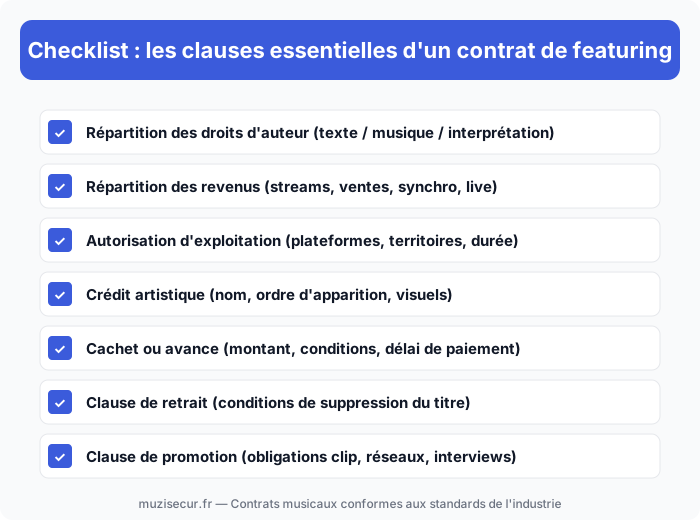
Checklist: the 7 must-have clauses in any featuring contract.
1. The copyright split
Who wrote what? What percentage for the lyrics, what percentage for the composition? This is the most important and most often overlooked point. We’ll detail it in the next section.
2. The revenue split (split sheet)
The split sheet defines how the revenue generated by the track is divided among all parties: lead artist, featured artist, producer, beatmaker, and any publisher. It covers streaming revenue, physical and digital sales, sync placements, and live performance income.
3. The exploitation authorization
The guest artist must expressly authorize the exploitation of their performance on the intended formats (streaming platforms, vinyl, CD, video, sync). Without this written authorization, you cannot legally distribute the track.
4. The artist credit
How will the featured artist be credited? “feat.”, “ft.”, “with”, “x”? In what order do the names appear? On the cover art, in the metadata, in the music video? These details seem trivial, but they’re a frequent source of conflict.
5. The fee or advance
Some featurings are free (visibility exchange), others involve a fee (fixed amount) or an advance on royalties (amount recoupable from future revenue). The contract must specify the amount, conditions, and payment deadline.
6. The withdrawal clause
What happens if the guest artist wants to withdraw their participation after release? The contract must provide for withdrawal conditions: is it possible? Within what timeframe? With what financial consequences?
7. Promotional obligations
Does the featured artist commit to promoting the track on their social media? To participating in the music video? To mentioning the track in interviews? These commitments must be formalized to avoid frustration.
Rights split: the most sensitive point
The rights split is the heart of the featuring contract. This is where most disputes arise. Here’s how to approach it in a structured way.
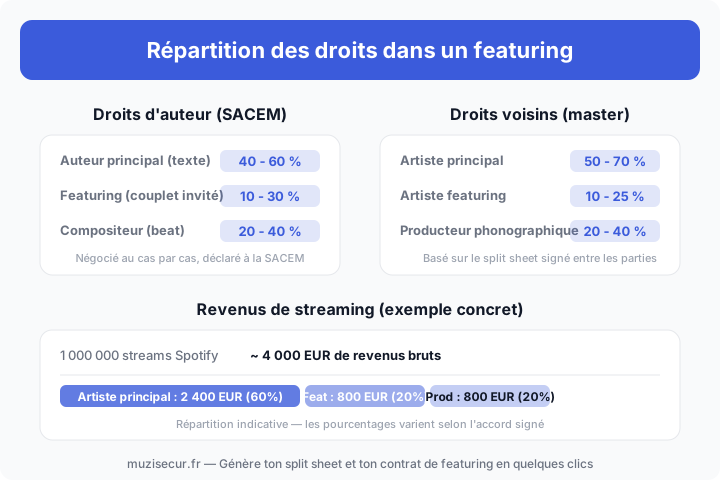
Diagram: how copyright (SACEM) and neighboring rights (master) are split in a typical featuring.
Copyright: the SACEM declaration
The copyright split is made at the time of the work declaration to SACEM. All co-authors must sign the declaration form, which specifies:
- Each person’s share of the lyrics (text)
- Each person’s share of the music (composition)
Concrete example: you write 100% of the lyrics except the featured artist’s verse (which represents about 25% of the words). The beatmaker composed the entire instrumental. A possible split would be:
| Contributor | Lyrics | Music | Overall share |
|---|---|---|---|
| Lead artist | 75% | 0% | 37.5% |
| Featured artist | 25% | 0% | 12.5% |
| Beatmaker | 0% | 100% | 50% |
This split is free and negotiable. There is no rule imposed by SACEM — it’s up to the co-authors to agree. Hence the crucial importance of the contract.
Neighboring rights: the master split
The master split (recording) is separate from copyright. It concerns the revenue generated by the exploitation of the recording: streams, sales, sync placements.
Here, the split is between:
- The lead artist (who drives the project)
- The featured artist (who contributes their vocal performance)
- The phonographic producer (who financed the recording)
A common split is 60/20/20, but everything depends on the power dynamic, the respective fame of the artists, and who financed the production.
Pitfalls to avoid
- Don’t confuse copyright and neighboring rights: an artist can earn 0% in copyright (if they didn’t write) but 20% in neighboring rights (as a performer)
- Don’t forget the beatmaker: they are often a co-author (composer) and their share must be included in the overall split
- Don’t leave the split “for later”: that’s a guaranteed future conflict
Key takeaway: Set the rights split BEFORE entering the studio. Put it in writing. Get it signed. This is non-negotiable.
Exploitation authorization: leave nothing to chance
The exploitation authorization is the clause that allows you to distribute, promote, and monetize the track legally. Without it, the featured artist can at any time object to the exploitation of their performance.
What the authorization must cover
The exploitation authorization must be precise and exhaustive. It must specify:
- Formats: streaming (Spotify, Apple Music, Deezer, etc.), download, physical format (CD, vinyl), video (music video, lyric video), radio, television
- Territories: France, Europe, worldwide — be as broad as possible
- Duration: limited (3, 5, 10 years) or unlimited — to be negotiated depending on context
- Derivative uses: sync (advertising, film, TV show, video game), samples, remixes, live versions
- Social media: right to use excerpts on Instagram, TikTok, YouTube Shorts, etc.
Sync: an often-forgotten point
Sync — placing a track in an advertisement, film, or TV show — is a considerable revenue source. But to place a track in sync, you need the agreement of all rights holders, including the featured artist.
If your featuring contract doesn’t explicitly provide for sync authorization, you’ll have to recontact the guest artist for each opportunity. And if they refuse, or if they’re unreachable, you lose the deal.
That’s why it’s recommended to include a pre-authorized sync clause in the initial contract, possibly with a financial threshold above which the featured artist’s consent is required.
Image rights
Don’t forget that the featured artist potentially appears in the music video, on the cover art, and in promotional visuals. Their image rights must be covered by the contract. Specify:
- Whether they participate in the video (and under what conditions)
- Whether their name and photo can be used for promotion
- Whether they have approval rights over visuals
Fee, advance, and compensation: how to negotiate
The money question is obviously central. There are several compensation models for a featuring, and the choice depends on the power dynamic between the artists.
The free featuring (visibility exchange)
This is the most common model between artists of comparable fame. Each brings their fanbase, nobody pays anyone. Compensation comes solely through the revenue split (streams, sales, etc.).
Even in this case, a contract is essential to set that split.
The fixed fee
The guest artist receives a fixed amount in exchange for their participation. This model is common when the featured artist has greater fame. The fee can range from 500 EUR to tens of thousands of euros depending on the artist’s profile.
Points to specify in the contract:
- The exact fee amount
- Whether the fee is recoupable or not against royalties (advance vs. net fee)
- The payment deadline and method (before or after recording)
- Whether the fee also covers exploitation rights or only the studio performance
The royalty advance
The featured artist receives an advance that will be deducted from their share of future revenue. Once the advance is recouped, they start earning their share normally. This model is used by labels and more established structures.
The hybrid model
Some deals combine a fixed fee + a royalty share. For example: 2,000 EUR fee + 15% of net revenue. This is often the fairest model when there’s an imbalance in fame.
| Model | Lead artist pays | Featured artist earns | Best for |
|---|---|---|---|
| Free | Nothing | Royalty share only | Artists at the same level |
| Fixed fee | Fixed amount | Fee, no royalties | Famous guest artist |
| Advance | Recoupable advance | Advance + royalties after recoup | Structured labels |
| Hybrid | Fee + royalties | Fee + revenue share | Fame imbalance |
Real-life featuring disputes
To understand why the featuring contract isn’t optional, here are real situations (anonymized) that illustrate the risks.
Case 1: The featuring that blocks the release
An independent rapper records a track with a more well-known artist. No contract is signed. The track is mixed, mastered, ready to go. At the time of distribution, the guest artist demands 40% of the revenue instead of the verbally agreed 15%. The lead artist refuses. Result: the track never comes out. Months of work and investment lost.
Case 2: The platform claim
Two artists release a featuring without a split sheet. Artist A’s distributor declares 100% of the rights. Artist B’s distributor does the same. Both distributors file a claim on the platforms. Spotify and Apple Music freeze the revenue until the conflict is resolved. For 8 months, nobody earns a cent.
Case 3: The missed sync deal
A featuring track is spotted by a brand for a TV ad. The proposed budget is 15,000 EUR. But the featured artist is unreachable — they changed their number, they’re on tour, their management isn’t responding. Without a pre-signed sync authorization, the deal falls through.
Case 4: The featuring that turns against you
An artist does a featuring with another rapper. Six months after release, the featured artist is involved in a public controversy. The lead artist wants to pull the track from platforms. But without a withdrawal clause in the contract, they can’t do it unilaterally — the featured artist objects and the track stays online, associated with the controversy.
Key takeaway: Each of these disputes would have been avoided with a well-drafted featuring contract. The contract doesn’t prevent conflicts, but it provides a framework to resolve them.
Featuring without a contract: the real risks
Let’s summarize the concrete consequences of a featuring without a collaboration contract.
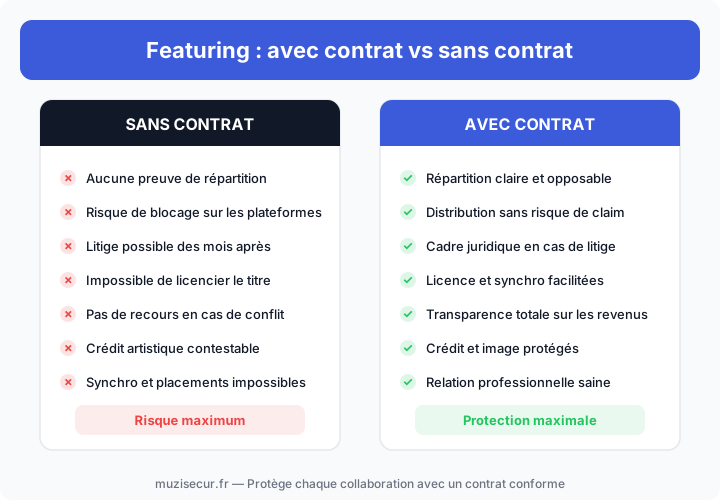
Comparison: the consequences of a featuring with and without a signed contract.
Legal risks
- Infringement: exploiting an artist’s performance without their written authorization can be classified as infringement (Articles L.335-2 and following of the CPI)
- Distribution block: platforms can remove the track in case of a rights dispute
- Lawsuit: the featured artist can claim damages
Financial risks
- Revenue freeze: platforms freeze royalties in case of conflicting claims
- Lost opportunities: impossible to close sync or license deals without authorization from all rights holders
- Legal fees: even a simple dispute can cost several thousand euros
Relationship risks
- Broken trust: a financial conflict destroys artistic relationships
- Reputation: being known as an artist who “doesn’t pay” or who “scams their feats” can close many doors
To better understand the difference between an artist contract and a license deal (two legal frameworks that can govern a featuring), check out our dedicated article: Artist Contract vs License Deal: Which to Choose?.
The most common mistakes in featuring contracts
Even when a contract exists, it’s often poorly drafted. Here are the most common mistakes.
1. Not distinguishing copyright from neighboring rights
Many featuring contracts mention only a single overall percentage, without specifying whether it refers to copyright (SACEM), neighboring rights (master), or both. This ambiguity is a ticking time bomb.
Best practice: detail the copyright split AND the master revenue split separately.
2. Forgetting the exploitation duration
A contract that doesn’t specify the exploitation duration leaves the door open to interpretation. Did the featured artist assign their rights for 3 years? 10 years? For life? Without clarification, a judge could consider the authorization to be time-limited.
Best practice: specify a clear duration, ideally the legal duration of neighboring rights protection (70 years after first publication for recordings under French law).
3. Not including a mediation clause
In case of disagreement, the reflex is often to go straight to court. That’s lengthy, expensive, and destructive. A mediation clause requires the parties to attempt an amicable resolution before any legal proceedings.
4. Drafting the contract after release
This is the classic mistake: you tell yourself you’ll “sort it out later.” But after release, the power dynamic changes. If the track does well, the featured artist will want to renegotiate upward. If the track flops, nobody wants to sign anything.
Best practice: sign the contract before recording or at the very latest before distribution.
5. Using a template found online
Free templates found online are rarely adapted to French intellectual property law. They often omit essential clauses (moral rights, jurisdiction, applicable law) and can create more problems than they solve.
How Muzisecur simplifies featuring management
At Muzisecur, we know that most independent artists aren’t lawyers. And we also know that featurings are often decided within 24 hours — no time to consult an attorney.
That’s why Muzisecur offers ready-to-use featuring contracts, compliant with French intellectual property law and music industry standards. In a few clicks, you generate a contract that covers:
- The copyright split (SACEM declaration)
- The master revenue split (split sheet)
- The complete exploitation authorization (formats, territories, duration, sync)
- Artist credit and image rights
- The fee or advance with payment terms
- The withdrawal clause and termination conditions
- The mediation clause in case of dispute
You enter each party’s information, adjust the percentages, and get a PDF document ready to sign. No more dubious templates found on Google, no more paying 500 EUR in legal fees for a feat.
Muzisecur also handles revenue tracking, declaration compliance, and contract archiving. Everything is centralized, accessible, and compliant.
Key takeaway: With Muzisecur, you can generate a professional featuring contract in under 10 minutes. No excuse not to have one.
FAQ: featuring contract
Does a WhatsApp message or email count as a featuring contract?
No. A WhatsApp message or email may serve as partial evidence, but it’s not a contract in the legal sense. For the agreement to be fully enforceable, it must be formalized in a signed document that details the rights split, exploitation authorization, and financial terms. Under French intellectual property law, a written document is required for any rights transfer (Article L.131-2 of the CPI).
Who should draft the featuring contract: the lead artist or the guest artist?
In practice, it’s usually the lead artist (or their label/management) who drafts the contract, since they’re the one driving the project. But the featured artist should review it carefully and negotiate any clauses that don’t work for them. Ideally, use a tool like Muzisecur that generates a balanced contract by default.
What if the featured artist refuses to sign a contract?
That’s a red flag. If an artist refuses to formalize the terms of a collaboration, it’s either out of ignorance (in which case you can explain the benefits) or because they want to keep room to renegotiate later. In both cases, don’t release the track without a signed contract. The risk is too high.
Do I need a different contract for each featuring?
Yes. Each featuring is a separate collaboration with potentially different terms (split, fee, authorization). You can use a standard template that you customize for each collaboration, but each featuring must have its own separately signed contract.
Is a featuring contract necessary even between friends?
Especially between friends. It’s precisely in close relationships that financial disputes cause the most damage. A contract protects the relationship as much as it protects the rights. As they say in the industry: clear agreements make lasting friendships.
What’s the difference between a featuring contract and a split sheet?
The split sheet is a document that only defines the revenue split between contributors. The featuring contract is broader: it includes the split sheet but also covers exploitation authorization, artist credit, fee, promotional obligations, and termination conditions. The split sheet is a component of the featuring contract, not a substitute.
How much does a featuring contract cost with a lawyer?
A lawyer specializing in music law charges between 300 and 800 EUR for drafting a featuring contract. It’s a justified investment for major projects, but often disproportionate for an independent artist. That’s why tools like Muzisecur offer compliant contracts at a fraction of that cost.
Conclusion
The featuring contract isn’t a luxury reserved for artists signed to major labels. It’s a fundamental protection tool for any artist who collaborates with others. It protects your rights, your revenue, and your professional relationships.
The key points to remember:
- Always sign a contract BEFORE recording — not after, not “when the track blows up”
- Distinguish copyright and neighboring rights in the split
- Detail the exploitation authorization: formats, territories, duration, sync
- Specify the fee and payment terms in writing
- Include a withdrawal and mediation clause to anticipate conflicts
- Declare the work to SACEM with the correct split
You don’t need to be a lawyer to protect your music. You need the right tools. Muzisecur lets you generate featuring contracts that comply with industry standards in just a few minutes. Because the best collaboration is one where everyone knows exactly where they stand — before you even press “rec.”
Related articles

Cover Songs: What Rights, Permissions, and Royalties Apply?
Covering a song in France involves specific rights. This guide details the permissions, licenses, and royalties for every platform.

Music Rights: The Complete Guide for Independent Artists (2026)
Copyright, neighboring rights, SACEM, ADAMI, SPEDIDAM, SCPP, SPPF: finally understand all music rights and how to collect every euro you are owed as an independent artist.

Music Publishing: Everything You Need to Know About the Publisher's Role
Music publisher, publishing deal, SACEM splits, sync, sub-publishing: the complete guide to music publishing in France and how to decide between a publisher and self-publishing.